Opening a restaurant, hotel kitchen, catering facility, or central kitchen in Dammam requires more than purchasing professional cooking equipment. Successful commercial kitchen operations depend on thoughtful planning, correct equipment selection, production capacity, efficient workflow, and reliable technical infrastructure.
Commercial kitchen planning in Dammam is especially important for businesses preparing to serve growing customer demand while controlling operating costs and maintaining consistent food quality.
From independent restaurants to large-scale catering facilities, every commercial kitchen needs a layout that supports daily operations without unnecessary movement, production delays, or equipment bottlenecks.
This guide explores seven essential considerations to help foodservice businesses plan efficient, scalable, and practical commercial kitchens in Dammam, Saudi Arabia.
1. Define Your Kitchen’s Operational Requirements
The first step in commercial kitchen planning in Dammam is understanding how the facility will operate.
A quick-service restaurant has different production requirements from a fine-dining restaurant, hotel kitchen, or industrial catering operation.
Before selecting equipment, identify your business model, expected customer volume, menu complexity, operating hours, and peak service periods.
For example, a restaurant serving 150 meals per day may need a very different kitchen setup from a catering facility producing 1,500 meals daily.
Consider the following questions:
What type of food will the kitchen prepare?
How many meals must be produced daily?
What is the expected peak-hour demand?
How many employees will work in the kitchen?
Will the business offer takeaway or delivery?
Is future expansion part of the business plan?
These answers create the foundation for equipment selection, capacity calculations, and kitchen layout design.
2. Choose the Right Commercial Kitchen Equipment
Equipment selection directly affects productivity, food quality, operating costs, and kitchen efficiency.
When planning commercial kitchen equipment in Dammam, businesses should choose machines based on production requirements rather than purchasing the largest or most expensive available models.
Common equipment categories include:
| Equipment Category | Typical Equipment | Main Purpose |
|---|---|---|
| Cooking | Ranges, combi ovens, fryers, griddles | Food preparation and cooking |
| Refrigeration | Upright refrigerators, freezers, cold rooms | Temperature-controlled storage |
| Preparation | Mixers, slicers, food processors | Ingredient preparation |
| Holding | Heated cabinets, bain-maries | Maintaining service-ready food |
| Washing | Commercial dishwashers, sinks | Cleaning and sanitation |
| Stainless steel | Worktables, shelving, counters | Hygienic preparation and storage |
Equipment should also be evaluated for energy consumption, maintenance access, spare-parts availability, utility connections, and durability.
Saudi Elan offers central kitchen equipment solutions for professional foodservice operations, including large-scale production requirements.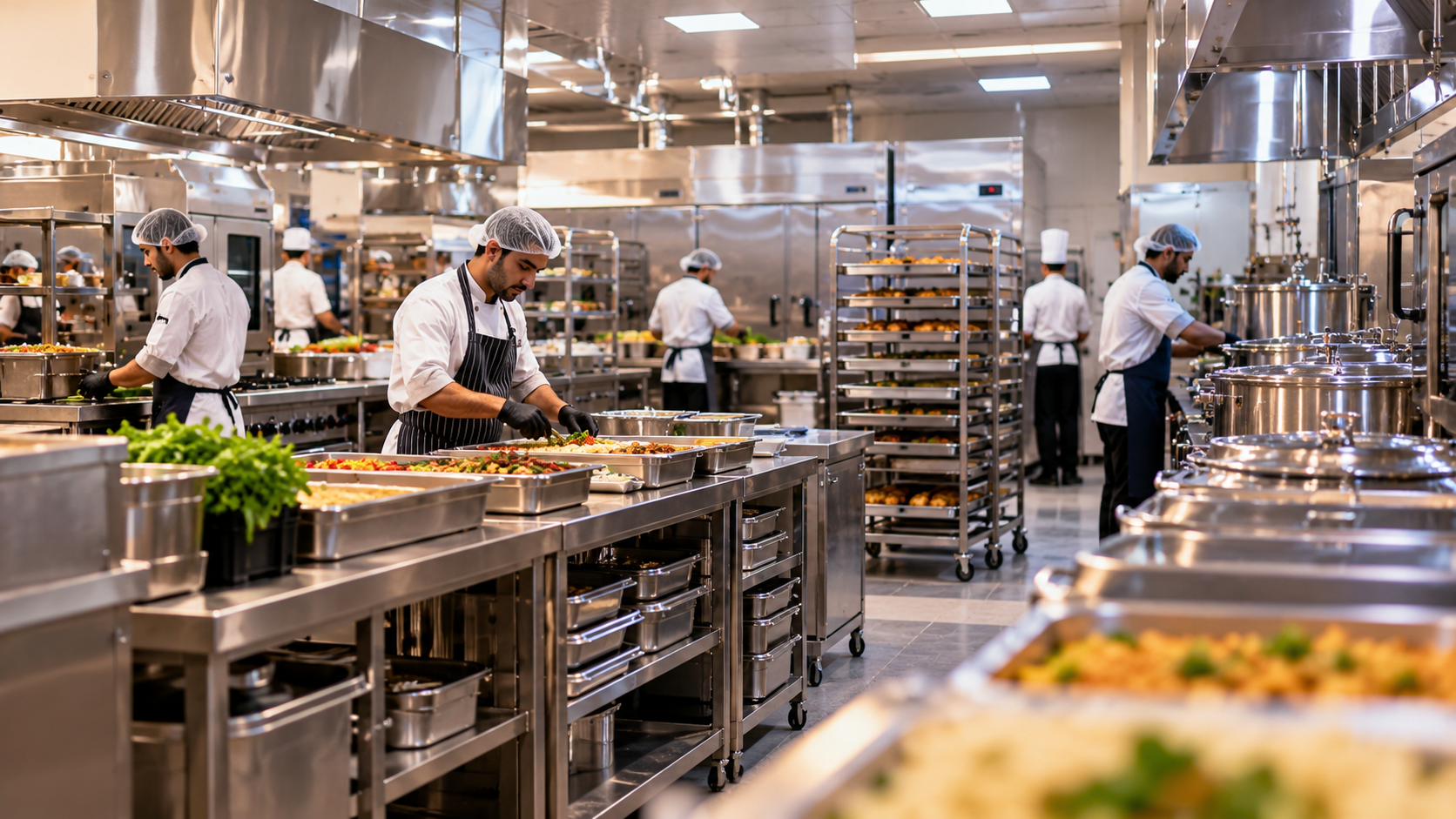
3. Calculate Kitchen Production Capacity Before Purchasing Equipment
One of the most important aspects of commercial kitchen planning in Dammam is production capacity.
Incorrect capacity planning can create operational problems even when high-quality equipment has been installed.
Undersized equipment may cause delays during busy service periods, while oversized equipment can increase capital costs and consume unnecessary kitchen space.
A practical starting point is to estimate peak production.
For example, consider a restaurant expecting 240 meals during a four-hour lunch service.
Illustrative production calculation
Meals per service
240
Service hours
4
Average meals/hour
60
This is the average output requirement, not the peak-hour equipment capacity.
However, if most customers arrive within two hours, the actual peak requirement could be significantly higher.
Restaurants should therefore calculate equipment requirements using peak demand, menu preparation time, cooking cycles, batch sizes, and staff availability.
Correct calculations help prevent bottlenecks and improve long-term operating efficiency.
4. Design an Efficient Commercial Kitchen Workflow
A well-designed kitchen should allow ingredients, employees, equipment, and finished food to move through the facility logically.
For commercial kitchen planning in Dammam, workflow design should be considered before finalizing the equipment layout.
A typical commercial kitchen follows this sequence:
Recommended kitchen workflow
Illustrative flow only. Actual layouts must also account for waste, washing, staff circulation, and separation of incompatible activities.
Poor kitchen layouts can result in unnecessary employee movement, cross-traffic between raw and cooked foods, delayed service, and inefficient equipment utilization.
An effective layout should separate activities where needed and provide adequate access for cleaning, maintenance, and staff movement.
For larger projects, professional technical engineering support can help coordinate equipment placement with operational and building requirements.
5. Consider Food Safety and Hygiene Requirements
Food safety should be incorporated into kitchen planning from the beginning rather than treated as an afterthought.
Saudi Arabia’s Food and Drug Authority (SFDA) publishes food hygiene requirements covering premises design, cleanliness, contamination prevention, ventilation, handwashing facilities, and appropriate temperature-controlled storage.
When designing a commercial kitchen in Dammam, businesses should consider separate preparation areas where required, accessible handwashing facilities, suitable drainage, adequate ventilation, and appropriate food storage.
Refrigeration systems must also provide enough capacity for ingredients during peak operating periods.
For additional guidance, review the official SFDA Food Hygienic Requirements.
The applicable licensing and inspection requirements should be confirmed for the specific facility and business activity before operations begin.
6. Plan Electrical, Gas, Water and Ventilation Requirements
A commercial kitchen relies on several interconnected building systems.
Equipment cannot operate efficiently if electrical supply, water pressure, drainage, gas connections, or ventilation capacity are inadequate.
During commercial kitchen planning in Dammam, project teams should evaluate:
Electrical demand and available supply
Gas requirements and applicable safety provisions
Water supply and drainage capacity
Ventilation and exhaust requirements
Heat generated by cooking equipment
Equipment installation dimensions
Maintenance and cleaning clearance
Dammam’s hot and humid coastal climate also makes indoor temperature management and refrigeration performance important design considerations.
Ventilation, refrigeration and air-conditioning systems should be coordinated rather than designed independently.
Saudi Elan offers technical engineering support covering utility coordination, technical requirements, performance testing, and documentation for professional kitchen projects.
7. Prepare for Maintenance and Future Expansion
Commercial kitchen planning should consider the complete equipment lifecycle.
Restaurant owners sometimes focus heavily on initial installation costs while overlooking maintenance access, repair requirements, and long-term operating expenses.
A poorly positioned oven or refrigerator may be difficult to service. Similarly, a kitchen designed with no spare utility capacity may require extensive modifications when production increases.
Before finalizing equipment specifications, businesses should evaluate maintenance access, replacement parts, service availability, and potential future expansion.
For restaurants and catering facilities in Dammam, choosing a supplier with regional technical support can be especially valuable.
Saudi Elan is headquartered in nearby Al Khobar and provides equipment supply, installation, repair, maintenance, and technical support for commercial foodservice projects across Saudi Arabia.
Explore Saudi Elan’s Repair and Maintenance Services for additional equipment lifecycle support.
Common Commercial Kitchen Planning Mistakes to Avoid
Even well-funded restaurant projects can experience operational problems when kitchen planning is rushed.
Common mistakes include purchasing equipment before confirming production capacity, underestimating peak demand, ignoring maintenance clearances, overlooking storage needs, and failing to coordinate ventilation and electrical requirements.
Another frequent mistake is choosing equipment based solely on initial purchase price.
The most suitable equipment should balance production performance, efficiency, durability, maintenance requirements, and long-term operating costs.
A properly planned kitchen should support the business’s menu and workflow instead of forcing the operation to adapt to unsuitable equipment.
Frequently Asked Questions
What is commercial kitchen planning in Dammam?
Commercial kitchen planning in Dammam involves designing a professional foodservice facility around equipment requirements, production capacity, workflow, food safety, utilities, and operational efficiency.
What equipment is required for a commercial kitchen in Dammam?
Typical equipment includes commercial ovens, cooking ranges, fryers, refrigerators, freezers, preparation equipment, dishwashers, stainless-steel worktables, and storage systems. Requirements depend on the menu and production volume.
How do I calculate commercial kitchen capacity?
Start by estimating daily meals, peak-hour demand, cooking time, batch size, and production workflow. Equipment should be selected to handle realistic peak production rather than average daily output alone.
Why is commercial kitchen workflow important?
Efficient workflow reduces unnecessary movement, helps avoid production bottlenecks, supports hygienic food handling, and improves service efficiency.
Does Saudi Elan provide commercial kitchen equipment for Dammam projects?
Saudi Elan provides commercial and central kitchen equipment solutions across Saudi Arabia. Its Al Khobar headquarters supports its regional presence in the Eastern Province, although project availability and service arrangements should be confirmed directly.
Should I plan for future kitchen expansion?
Yes. Businesses expecting higher production volumes, additional menu items, or more outlets should evaluate future equipment, storage, utility, and space requirements during initial planning.
Conclusion
Successful commercial kitchen planning in Dammam requires a balanced approach to equipment selection, production capacity, kitchen workflow, food safety, technical infrastructure, and maintenance.
A well-designed kitchen helps restaurants and foodservice businesses improve efficiency, maintain consistent production, and prepare for future growth.
Instead of purchasing equipment first and designing the kitchen around it, businesses should begin with their operational requirements.
The right equipment, supported by appropriate engineering and a practical workflow, creates a stronger foundation for long-term performance.
Planning a Commercial Kitchen Project in Dammam?
Saudi Elan provides professional commercial and central kitchen equipment solutions, technical engineering support, installation, commissioning, and after-sales services across Saudi Arabia.
Whether you are developing a restaurant, catering facility, hotel kitchen, or central production operation, Saudi Elan can help you evaluate equipment and project requirements.
Explore Saudi Elan’s Central Kitchen Equipment or contact Saudi Elan to discuss your project.